Our vision
The vision of TVC is to influence the world for Christ by making the gospel known. At the same time we seek to be a church where families and communities are transformed by the Holy Spirit.
In fulfilling this vision, we:
● Welcome children, and adults at risk into the life of our community
● Run activities for children.
● Make our activities for children available to family, friends and the communities where we fellowship
Our safeguarding responsibilities
The following statement was agreed by the Trustees and Leadership of TVC.
● All children and adults at risk should never experience abuse of any kind,regardless of age, disability, gender reassignment, race, religion or belief,or sexual orientation. They all have an equal right to protection from all types of harm or abuse.
● TVC is committed to the safeguarding of children and adults at risk with care and support needs and ensuring their well-being.
● We recognise that we all have a responsibility to help prevent the physical, sexual, psychological, financial and discriminatory abuse and neglect of adults at risk and children, and to report any such abuse that we discover or suspect, as per our outlined procedure
● We undertake to exercise proper care in the appointment and selection of those who will work with children and adults at risk, according to our outlined Recruitment procedures.
● We believe every child should be valued, safe and happy, and under take to make all Safeguarding Leads known to both children and adults at risk.
We are committed to
● Following statutory denominational and specialist guidelines in relation tosafeguarding children and adults at risk and will ensure that as a place of worship all workers will work within the agreed procedure of our safeguarding policy.
● Implementing the requirements of the Disability Discrimination Acts 1995and 2005, Equality Act 2010 and all other relevant legislation.
● Supporting, resourcing and training those who undertake working with ourchildren in both a teaching and vounteering capacity.
● Ensuring that we are keeping up to date with national and local developments relating to safeguarding, and providing annual training for all our children’s ministry teachers and safeguarding leads.
● Ensuring that our Safeguarding Lead and Safeguarding Deputy receive updated training with our provider, Thirtyone:eight and review our Safeguarding Policy on an annual basis.
● Ensuring that everyone agrees to abide by these recommendations and the guidelines established by this place of worship/organisation.
● Supporting all in TVC affected by abuse.
We recognise
● Safeguarding is everyone’s responsibility.
● Children’s Social Services has the lead responsibility for investigating allallegations or suspicions of abuse where there are concerns about a child.Adult Social Care has the lead responsibility for investigating allallegations or suspicions of abuse where there are concerns about anadult with care and support needs.
● Where an allegation suggests that a criminal offence may have been committed then the police should be contacted as a matter of urgency.
We will review this statement and our policy annually to make sure they remain relevant and effective.
A copy of the full Thames Valley Churches of Christ policy and procedures is available by request using: admin@thamesvalley.church.
GOVERNANCE
Good governance helps an organisation prevent abuse and means it can respond quickly and with integrity when concerns arise. Central to this, is the “Board of Trustees”.
Our “Board of Trustees” has independent authority and legal responsibility for how TVC governs its congregation, and has a critical role in decision making and compliance as well as setting the values, standards and behaviours of the organisation. The standards and behaviours may be referred to as the culture of TVC or “the way we do things around here”. Culture can be shaped in both negative andpositive ways.The board, as well as the Safeguarding Team are therefore to hold allthose in positions of trust accountable for any forms of cultural or institutional abuse(see 5.1), whether intentional or not.
The culture of a TVC goes beyond mere compliance with legal and regulatory demands. Our governance is most effective when it provides assurances not justthat legal requirements are met, but that the behaviour of people working for orvolunteering with TVC, and those who come into contact with it, is proper andethical. Culture, alongside good governance, can be pivotal to whether TVC achieves its stated objectives.
Positions of Trust
All adults working with children, young people and vulnerable adults are in a position of trust. All those in positions of trust need to understand the power this can give them over those they care for and the responsibility they have because of this relationship.
It is vital that all workers and volunteers ensure they do not, even unknowingly, use their position of power and authority inappropriately. They should always maintain professional boundaries and avoid behaviour which could be misinterpreted.
As of April 2022 it is illegal for those in Positions of Trust in a faith setting to engage in sexual activity with a 16 or 17 year old under their care or supervision.
The following Safeguarding Policy and Statement aims to not only meet the requirements of ensuring a safe environment for those accessing activities in TVC but to also build an open culture where those who lead do so by example and with respect and are committed to the safeguarding of all those that work or volunteer. Itaims to ensure that volunteers are safely recruited and trained for their roles, thereare clearly communicated accountability structures with codes of conduct and thevalues of TVC are embedded in the day to day actions and behaviours of its people.
Our commitment
As a Trustee Board and the Leadership of TVC we recognise the need to provide a safe and caring environment for children, young people and adults.
We acknowledge that children, young people and adults can be the victims of physical, sexual and emotional abuse, and neglect.
We accept the UN Universal Declaration of Human Rights and the International Covenant of Human Rights, which states that everyone is entitled to “all the rights and freedoms set forth therein, without distinction of any kind, such as race, colour, sex, language, religion, political or other opinion, national or social origin, property, birth or other status”.
We also concur with the Convention on the Rights of the Child which states that children should be able to develop their full potential, free from hunger and want, neglect and abuse. They have a right to be protected from “all forms of physical ormental violence, injury or abuse, neglect or negligent treatment or exploitation,including sexual abuse, while in the care of parent(s), legal guardian(s), or any otherperson who has care of the child.” As a Leadership we have therefore adopted theprocedures set out in this safeguarding policy in accordance with statutory guidance.
We are committed to build constructive links with statutory and voluntary agencies involved in safeguarding.
This policy and any attached practice guidelines / appendices are based onthe ten safeguarding standards published by Thirtyone:eight (thiryoneeight.org/ten-standards)
PREVENTION OF HARM
Understanding abuse and neglect
Defining child abuse or abuse against an adult is a difficult and complex issue.
A person may abuse by inflicting harm or failing to prevent harm. Children and adults in need of protection may be abused within a family , an institution such as a church, or a community setting. Very often the abuser(s) is known or in a trusted relationship with the child or adult.
To safeguard those in our places of worship and within TVC as an organisation, we adhere to the UN Convention on the Rights of the Child and have as our starting point as a definition of abuse, Article 19:
1. States Parties shall take all appropriate legislative, administrative, social andeducational measures to protect the child from all forms of physical or mentalviolence, injury or abuse, neglect or negligent treatment, maltreatment orexploitation, including sexual abuse, while in the care of parent(s), legalguardian(s) or any other person who has the care of the child.
2. Such protective measures should, as appropriate, include ef fectiveprocedures for the establishment of social programmes to provide necessarysupport for the child and for those who have the care of the child, as well asfor other forms of prevention and for identification, reporting, referral,investigation, treatment and follow-up of instances of child maltreatmentdescribed heretofore, and, as appropriate, for judicial involvement.
Also for adults the UN Universal Declaration of Human Rights with particular reference to Article 5:
No one shall be subjected to torture or to cruel, inhuman or degrading treatment or punishment.
In addition, we also adhere to the 2021 Church of England definition of Spiritual abuse as from 2021:
(All children and adults in the TVC setting shall be protected from) any form of emotional and psychological abuse characterised by a systemic pattern of coercive and controlling behaviour.Detailed definitions, and signs and indicators of abuse, as well as how to respond to a disclosure of abuse, are included here in our policy. APPENDIX 6.
Safer recruitment
The Trustees and Leadership team are committed to safer recruitment practices. When recruiting paid staff, the following process will be applied:
1) We will develop a clear role profile, person specification and application form;
2) When advertising a role which involves working with children or adults at risk we will make it clear that any appointment may be subject to a DBS check at the appropriate level;
3) All applicants will be asked to complete an application form and include the names of two referees;
4) Shortlisting of applicants will be carried out by at least two people, including the line manager or group leader directly overseeing the role being recruited for;
5) Interviews will be carried out by at least two people, including the line manager or group leader;
6) References, a Self-Disclosure Form and an enhanced DBS check must be completed satisfactorily before the appointed person starts in their role.
7) A suitable training programme is given to the successful applicant.
Note: Under the Criminal Justice and Court Services Act 2000, it is an offence for anyone disqualified from working with children or adults at risk to knowingly apply, accept or offer to work with children or adults at risk. It is also a criminal offence toknowingly offer work with children or adults at risk to an individual who is sodisqualified or to knowingly allow such an individual to continue to work with childrenor adults at risk.
Additional checks for paid workers
In addition to the above checks which should be completed for paid workers, anapplicant’s UK residency status and/ or right to work in the UK will be checked whenrecruiting for a paid role.
References
Formal written references will be requested, ideally in the form of at least one professional and one personal reference. References should not be sought from family members.
Appointment and Supervision
The church’s safeguarding policy and procedures will be discussed with the applicant and they will be required to sign their agreement to adhere to them. Allworkers will have a role description and clear lines of accountability to a leader andthe leadership team.
Paid workers will also have an assigned supervisor with whom they will meet regularly to discuss work and address any issues or areas of concern. There will be a probationary period of six months in the role before any paid appointment is confirmed.
There will also be regular team meetings to review procedures, share concerns and identify other matters that may need clarification and guidance.
Recruitment of Children’s Ministry and Youth Helpers
Children’s Ministry teachers and Youth Helpers volunteer their services to TVC on a temporary basis, and do so in line with an organised teacher/volunteering rota. Allvolunteers have to be over the age of 18 and in possession of an up to date DBScertificate. This process is overseen by the Safeguarding Recruiter, and facilitated byThirtyone: Eight, our regulating Safeguarding body. As part of our vetting process,TVC paid staff are responsible for ensuring the membership, suitability, identity and security checks before volunteers can begin their DBS application process. All volunteers participate in an annual Safeguarding Training workshop to ensure good practice. Volunteers are clearly identified at church meetings and the SafeguardingTeam helps to ensure nobody who has not been recruited in line with the TVC policyis ever put in a position of trust.
Young helpers under 18 years of age
By law, young helpers under the age of 18 are children and cannot be treated as adult members of a team. Training and mentoring will be given to ensure that theyare helped to develop and hone their skills, attitudes and experience. Young helpersmust always be closely supervised by an adult leader and never given soleresponsibility for a group of children. When considering ratios of staff to children,young helpers need to be counted as children, not leaders. The safeguarding procedures apply to a young helper just as they do to any other person. Parent /carer permission needs to be sought for young helpers to attend an event or helpwith a children’s event, just as you would for any other person under 18 years of age.
Safeguarding training & signposting
The Leadership is committed to on-going safeguarding training and development opportunities for all paid staff and volunteers, developing a culture of awareness of safeguarding issues to help protect everyone. The TVC Safeguarding Team will also ensure that children and adults with care and support needs are provided with information on where to get help and advice in relation to abuse, discrimination, bullying or any other safeguarding matter or concern. Location Safeguarding representatives will also signpost external agencieswhere appropriate.
Safer Behaviour
The church has a code of behaviour for all those working with children and/or adultsat risk so that everyone is shown the respect that is due to them:
• Treat everyone with dignity and respect.
• Use considered, respectful language and tone of voice when engaging with children, young people and adults at risk.
• Be aware of your body language and the effect you are having on those you are working with. This applies to both in person and online interactions.
• Listen well to everyone. Be careful not to assume you know what a child oradult at risk is thinking or feeling. Listen to what is being spoken and how it is said. At the same time, observe the individual’s body language to better understand what is being said.
• Be aware of any physical contact you may have with a child or adult at risk and record it when necessary. For instance, if you need to stop a fight,administer First Aid, give a hug to someone in distress, or protect yourself orothers from danger.
• Do not make sexually suggestive comments about or to a child or adult at risk, even in 'fun'.
• Do not scapegoat, belittle, ridicule or reject any child or adult.
• Keep a record of any significant incidents or concerns on a SafeguardingIncident Form (see Appendix 7 flowchart)
Specific considerations when working with children
● Do not invade the privacy of children when they are using the toilet or showering.
● The level of assistance with personal care (e.g. toileting) must be appropriate and related to the age of the child, whilst also accepting that some children have special needs.
● When playing contact games and sports, children’s ministry workers as well as youth workers will be completing a Risk Assessment form which would help protect the safety of children.
● Avoid sexually provocative games.
● Never use your personal device to photograph or video a child, unless you have clear and specific permission from the SGL. When it is necessary to discipline children, this should be done without using physical punishment or harmful language. There may, however, on the rare occasion be circumstances where a child needs to be restrained in order to protect them or a third person. These incidents will always bereported to a SG Rep or the SGL.
● Notify the Safeguarding lead / deputy of any children’s trips which take place in the name of the church. Parental permission must always besought and the church platform, Church Suite used to provide relevantinformation on those in attendance.
● If a church event is hosted at a private home, the SGL will need to be notified and relevant RA completed.
● Do not give lifts to children or young people on your own. Ensure that iftransporting children as part of your church role, you have the correctinsurance cover in place as well as parental permission. No person under 18 years of age should be left in sole charge of any children of any age.
● Young children under the age of 16 are not to be left alone without adult supervision.
No one should normally be left working alone with children, young people or adults at risk, but should instead work as part of a team. If there are insufficient volunteers forgroups:
● Internal doors should be left open.
● At least two people should be present before external doors are opened for an event.
● Consider whether you could combine groups together or rearrange planned activities.
● Reconsider whether you can run the group safely, carrying out a Risk Assessment to record your findings.
● Ask parents to supervise their own children
If volunteers do find themselves on their own with children or adults at risk, they should:
● Assess the risk of sending the child back to their parent/guardian or adult at risk home.
● Speak to their Safeguarding Representative.
● Phone another team member and let them know the situation.
If a child or adult at risk wants to talk on a one-to-one basis, the Incident Report flowchart for Thames Valley Church should be followed.*
Consideration should be given to how many workers should be involved with agroup. A couple or immediate family members should be considered to count as only one person when planning events or activities and the distribution of volunteers through different groups; for example if a couple or immediate family members want to work together then a third person will need to be assigned to that group. Wherever possible, couples or people who are related to each other should work with separate groups.
The only adults allowed to participate in children’s and adult at risk activities are those safely appointed and appropriately trained. The leader of the activity shouldbe aware of any other adults who are in the building whilst the activity is running.
Safer Community
Bullying
Bullying is another form of abuse, and it can be verbal or physical. Bullyingdoesn’t just happen to children; adults can be victims too. There is no legal definition of bullying, but it is usually defined as a repeated pattern of behaviour intended to cause emotional, psychological or physical harm to another person or exert power over them. The effect of bullying on the victim can be profound, both emotionally and physically, regardless of their age, ability or status.
It is important to recognise that bullying happens within churches, and it is not isolated to children and young people. Anyone in the church can be a victim ofbullying, just as anyone in the church can be the bully, including those inleadership. It is everyone’s responsibility, including the church Whistleblower,to speak up about bullying.
Some examples of bullying that could arise in the church context are:
● Being verbally or physically abusive towards another person
● Discriminating against an individual (including non-members or visitors)based on: Age, sex, disability, religion, sexual orientation, marriage/civil partnership, pregnancy/maternity, race (UK Equality’s Act 2010)
● Isolating or deliberately ignoring someone, or excluding them from group activities
● Spreading rumours and malicious untruths about another person in the church - in person, or online
● Use of email, phone or social media to publicly challenge or undermine someone
● Name calling and personal insults
● Making false accusationsAbusing positions of church leadership to belittle or shame another person, regardless of age.
● Sending abusive messages or degrading images via phone, email orsocial media
Bullying will always cause a great deal of pain and harm for those on the receiving end. Many people affected by bullying, both children and adults,believe they have nowhere to turn. They are scared to speak out and oftenblame themselves. They can become fearful and reclusive. It is important thatchurches are able to recognise when bullying is occurring and are prepared totake action to resolve the situation.
Some signs that can indicate a person is being bullied are as follows:
● Withdrawal from group or church activities; appearing anxious, tearful or more reticent than usual, particularly in a certain context; development of mental health difficulties, such as depression or anxiety disorders; drop in performance relating to any church roles; physical injuries.
In order to help prevent bullying, the following procedures will be adopted within the church:
●The children and young people will be involved in agreeing a code of behaviour for their groups, which makes it clear that bullying is unacceptable. This policy or agreement should be visible to all.
● Everyone in the church, whether children or adults, should know how they can report any incidents of bullying.
● All allegations of bullying will be treated seriously and details will be carefully checked before action is taken.
● The bullying behaviour will be investigated and bullying will be stopped as quickly as possible.
● An attempt will be made to help bullies change their behaviour.
● All allegations and incidents of bullying will be recorded, together with the actions that are taken.
● Where an allegation of bullying is made against a church or group leader, advice will be sought from the Safeguarding Lead and Trustee.
● Incidents of bullying may be reported to the statutory authorities in line with the church safeguarding procedures.
It is important to distinguish bullying respectfully disagreeing with someone else’s beliefs or behaviours, setting reasonable expectations with regard to work deadlines (church staff only) and activities or taking legitimate disciplinary action(paid Thames Valley Church staff)
Online safety
Thames Valley Church is committed to ensure all its members, including young people under the age of 18 are kept safe when accessing the Internet, including social media platforms. We acknowledge that church functions in community settings and cannot exist without online communication between members. In safeguarding our children and vulnerable adults from harm online, a specific *Online Safety Policy is in place to guide the use of technological communication. This document is reviewed annually, or as and when legislation in England changes relating to online safety. Thames Valley Church does not accept any responsibility for its adult members’ private online accounts or behaviour, unless risk of harm is suspected or reported.
Working with Alleged or Known Offenders
When someone attending the place of worship / organisation is known to have abused children, is under investigation, or is known to be a risk to adults with care and support needs; the Leadership will supervise the individual concerned and offer pastoral care, but in its safeguarding commitment to the protection of children and adults with care and support needs, set boundaries for that person, which they will be expected to keep. These boundaries will be based on a riskassessment and through consultation with appropriate parties and can form partof a contract with the individual.
An open discussion will be held with the person concerned which will contributeto the risk assessment and in which clear boundaries are established for theirinvolvement in the life of the church. A written contract will be drawn up whichidentifies appropriate behaviour. The person will be required to sign the contractand it will be monitored and enforced. If the contract is broken certain sanctionswill be discussed, considered and agreed.
In determining the details of the contract:
● The Safeguarding lead / deputy will carry out a risk assessment.
● There will be a discussion about who should be informed about the nature of the offence and the details of the contract.
● The rights of the offender to rebuild their life without people knowing the details of their past offence should be balanced against the need to protect children, young people and adults at risk.
● The members of the church Safeguarding Team will always be informed.
● The Safeguarding lead / deputy should determine whether the person is subject to supervision or is on the Sex Offenders' Register. If so, theSafeguarding lead / deputy should contact the offender's specialistprobation officer (SPO) who will inform the church of any relevantinformation or restrictions that they should be aware of.
Alleged or known offenders who are themselves adults at risk
A risk assessment and formal contract may be quite a daunting process forsomeone with learning difficulties or a young person yet having safeguards inplace is still necessary. Therefore, an alternative may be to arrange a meetingwith the individual in question where they can be taken through the mainelements of a formal contract in a way that is non-threatening and easy tounderstand. Notes would be taken and the individual would need to verbally agree to the requirements laid out in the meeting.
Rather than signing a formal ’contract’, the individual would instead sign to say that they agree with the minutes or meeting notes, and that they will stick to what has been agreed during the meeting. This will result in the same outcome as acontract but is a more informal and appropriate approach for an adult at risk. Theagreed requirements will need to be reviewed regularly to make sure that theindividual is complying, exactly as a formal contract would be. The church will work with the Regional Safeguarding Lead throughout this process.
PRACTICE GUIDELINES
As an organisation / place of worship working with children, young people and adults with care and support needs we wish to operate and promote good working practice.This will enable workers to run activities safely, develop good relationships and minimise the risk of false or unfounded accusations.
We have specific good practice guidelines for every activity we are involved in and these are attached or in the appendices.
PARTNERSHIP WORKING
The diversity of organisations and settings means there can be great variation in practice when it comes to safeguarding children, young people and adults. This can be because of cultural tradition, belief and religious practice or understanding, for example, of what constitutes abuse.
We therefore have clear guidelines with regards to our expectations of those with whom we work in partnership, whether in the UK or not. We will discuss with allpartners our safeguarding expectations and have a partnership agreement forsafeguarding. It is also our expectation that any organisation using our premises, aspart of the letting agreement, will have their own policy that meets Thirtyone:eight’s safeguarding standards.
We believe good communication is essential in promoting safeguarding, both to those we wish to protect, to everyone involved in working with children and adults and to all those with whom we work in partnership. This safeguarding policy is just one means of promoting safeguarding.We are currently working on our safeguarding policy.
POLICY FOR RESPONDING TO CONCERNS AND ALLEGATIONS
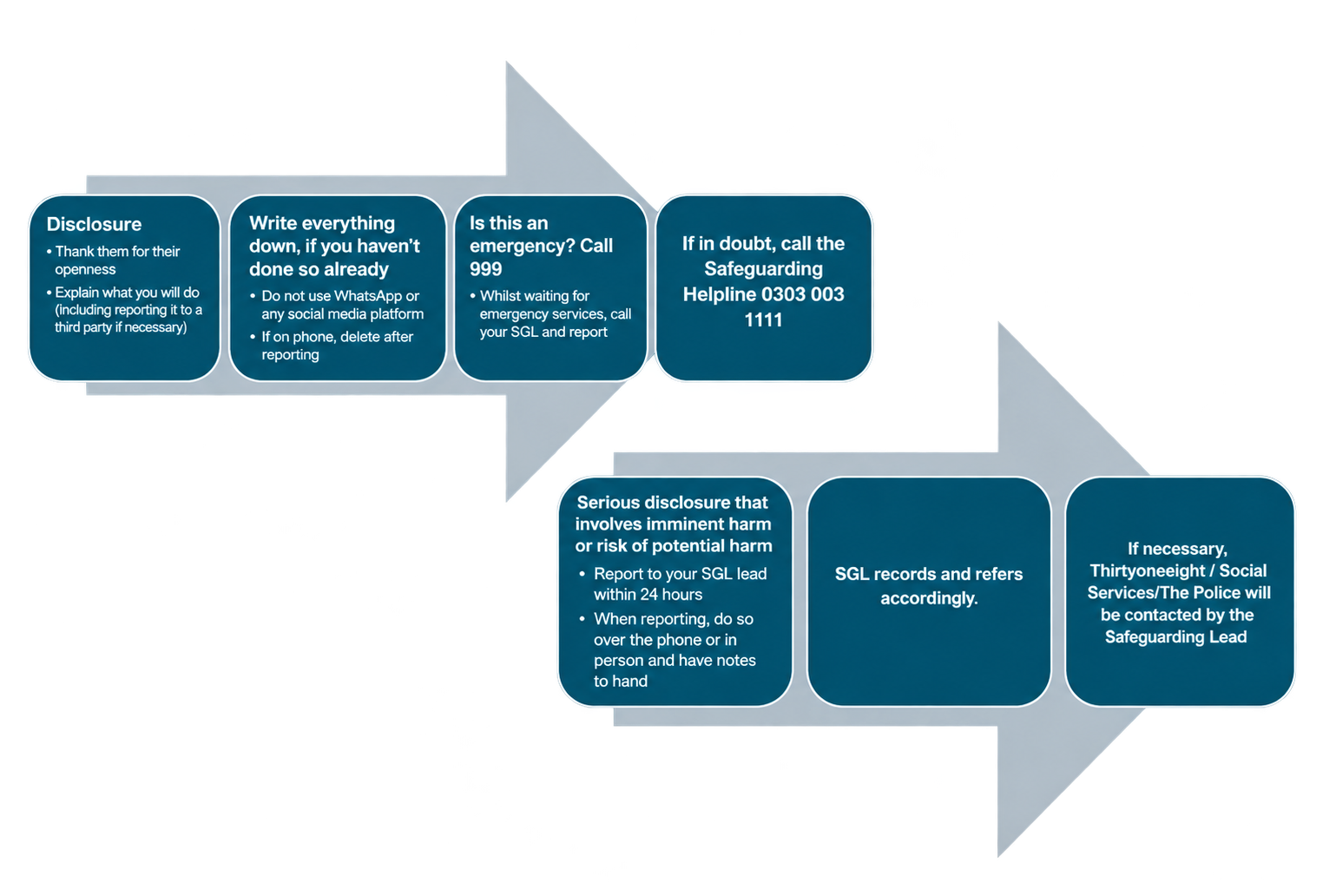
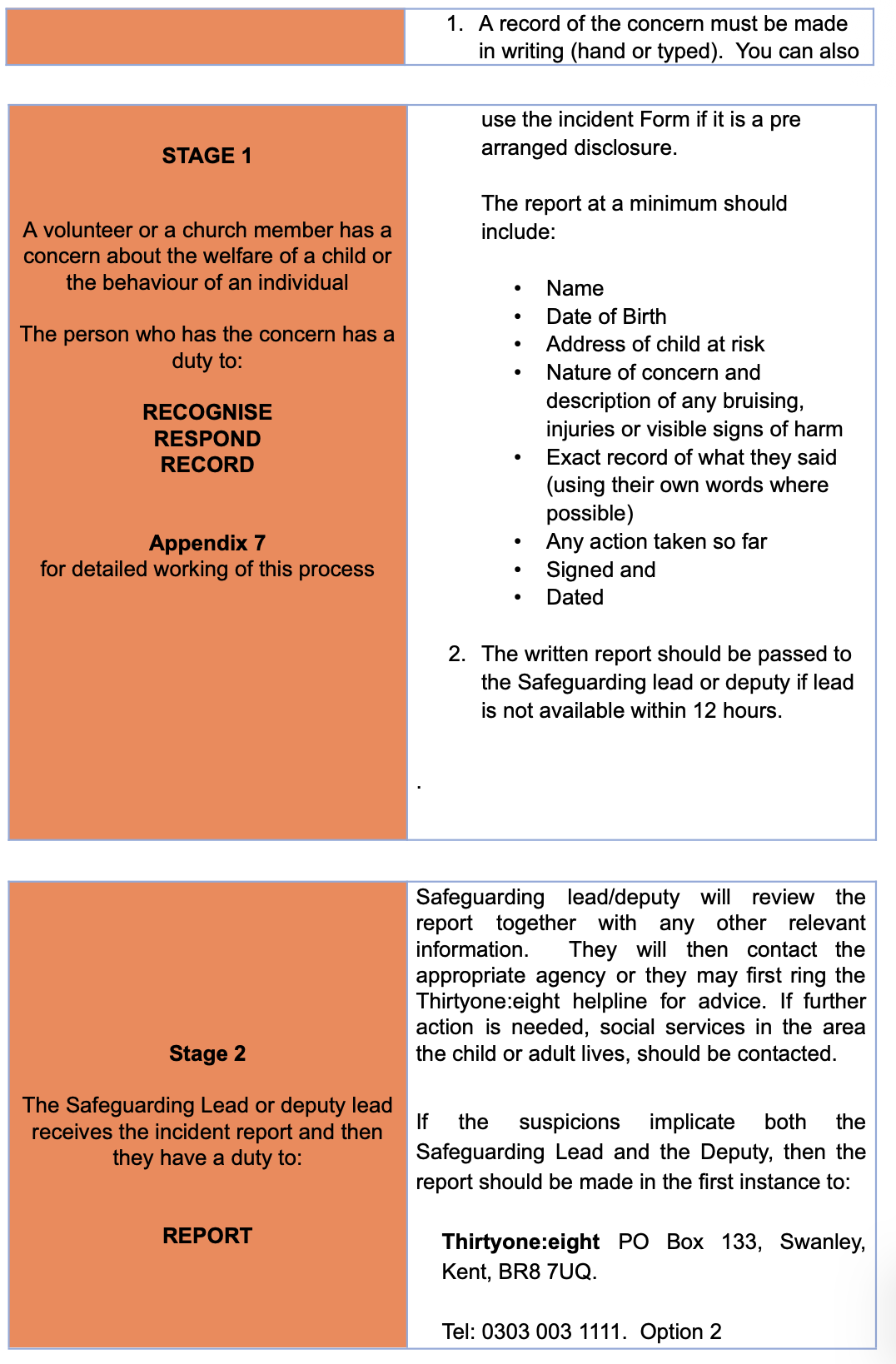
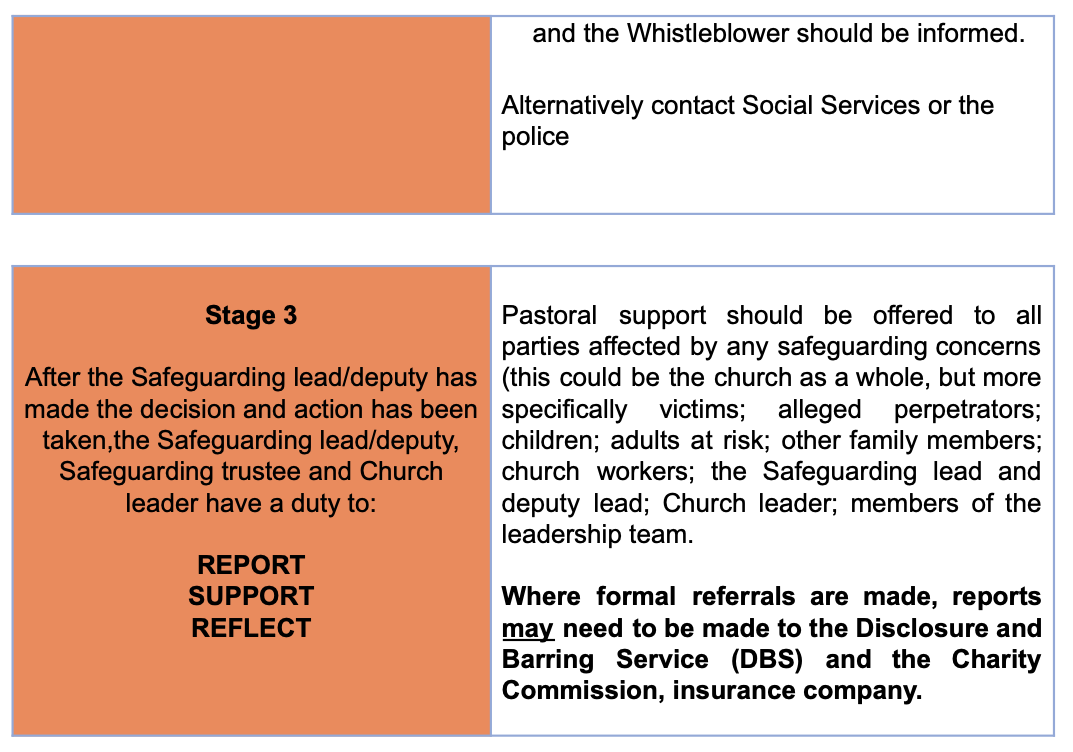
Thames Valley Church has appointed Anna Oliver as our Safeguarding Lead
If you have any concerns around the welfare of a child please contact her at atjoliver@gmail.com